
Hiring is as much an art as it is a science. Resumes show history, interviews show behavior, but neither fully reveals intent, honesty, or future growth. Over time, I’ve developed a simple mental framework that helps me listen better, judge more fairly, and reduce hiring risk. I call it the 4 Hiring Quadrants.
This model is not about catching candidates out. It’s about sense-making—organizing signals as the conversation unfolds and weighting them thoughtfully before making a decision.
The Idea Behind the Hiring Quadrants
During an interview, every answer, story, hesitation, or insight gives signals. Instead of reacting emotionally or relying on gut feel alone, I mentally place these signals into one of four quadrants:
- Truth
- Lie
- Mask
- Potential
As the interview progresses, I keep adding “points” to each quadrant. Early signals carry less weight; later signals—when patterns emerge—carry more. At the end, I don’t look for a perfect candidate. I look for where the weight accumulates.
The candidates I hire consistently show high weight in the Truth and/or Potential quadrants.
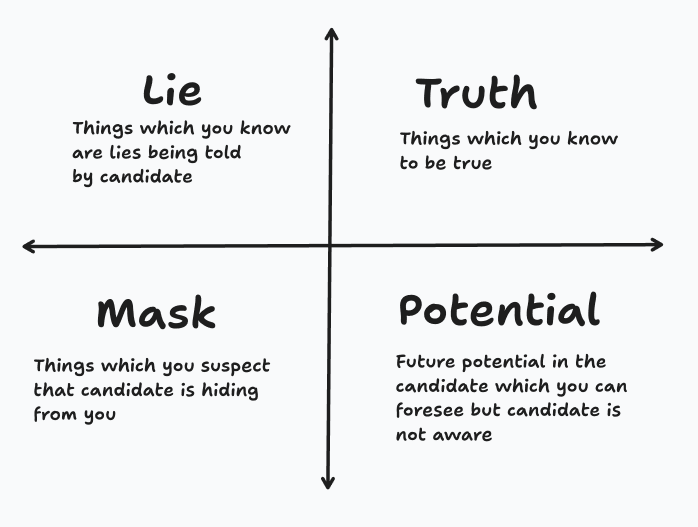
Quadrant 1: Truth
Things which you know to be true
The Truth quadrant captures statements and behaviors that are verifiable, consistent, and grounded in reality. These are moments when a candidate’s words align with facts, logic, and observable experience.
Examples include:
- Clear, consistent career timelines
- Specific examples with measurable outcomes
- Answers that match references, portfolios, or prior context
- Calm confidence without exaggeration
Truth is important because trust is non-negotiable. Skills can be taught, processes can be learned, but trust—once broken—is hard to rebuild.
As interviews progress, I look for internal consistency. Do their stories align across different questions? Do details remain stable when revisited from another angle? Each confirmation adds weight to this quadrant.
Quadrant 2: Lie
Things which you know are lies being told
The Lie quadrant contains signals where the candidate’s claims clearly contradict facts, logic, or themselves. This is not about nervousness or minor exaggeration—it’s about demonstrable falsehoods.
Examples include:
- Claiming ownership of work that clearly belonged to a team
- Inflated titles or responsibilities that don’t match company size or role
- Contradictory answers to the same question
- Dodging simple factual clarifications
This quadrant matters because lying is a choice, not a skill gap. Even if the candidate is talented, consistent deception introduces long-term risk to culture, customers, and teams.
One lie may be explainable. A pattern of lies is not. As weight accumulates here, the hiring decision becomes clearer—often in the form of a “no.”
Quadrant 3: Mask
Things which you suspect the candidate is hiding
The Mask quadrant is the most subtle—and the most human. It represents areas where you sense avoidance, discomfort, or selective storytelling, but lack certainty.
Examples include:
- Vague answers where detail should exist
- Overly polished responses that feel rehearsed
- Deflecting responsibility without outright lying
- Sudden changes in tone or energy around certain topics
This quadrant requires restraint. Assumptions can be dangerous. Not everything hidden is malicious—sometimes candidates are insecure, inexperienced, or afraid of being judged.
Instead of penalizing immediately, I probe gently:
- Rephrase questions
- Ask for examples
- Return to the topic later from a different angle
Over time, masked items often migrate—either into Truth (clarified) or Lie (exposed). The key is patience, not paranoia.
Quadrant 4: Potential
Future potential you can foresee, but the candidate may not
The Potential quadrant is where great hires are often born. It captures signals of growth that may not yet be fully realized—even by the candidate themselves.
Examples include:
- Strong problem-solving despite limited experience
- Curiosity and quality of questions asked
- Ability to connect ideas across domains
- Self-awareness about gaps and eagerness to improve
- Energy, resilience, and learning mindset
Potential matters because the future rarely looks like the past. Roles evolve. Teams change. People who can grow often outperform those who merely fit today’s requirements.
This quadrant carries increasing weight as the interview deepens. When a candidate consistently demonstrates learning ability, judgment, and drive, potential can outweigh missing skills.
How Weighting Works Over Time
Early in the interview:
- Signals are light
- Assumptions are minimal
- Everything is tentative
As the conversation continues:
- Patterns emerge
- Consistency (or inconsistency) becomes visible
- Quadrant weights increase
By the end, I don’t ask:
“Is this candidate perfect?”
I ask:
“Where is the heaviest weight?”
- High Truth + Potential → Strong hire
- High Lie → Clear rejection
- Heavy Mask, low Truth → Needs more probing or another round
- Moderate Truth, high Potential → Often a bet worth making
Why This Framework Works
The 4 Hiring Quadrants works because it:
- Reduces emotional bias
- Separates facts from intuition
- Encourages listening over judging
- Balances honesty with future promise
Most importantly, it reminds us that hiring is not about catching mistakes—it’s about understanding people.
In the long run, the best hires are rarely those with flawless resumes. They are the ones who are truthful, self-aware, and full of unrealized potential.
That’s where I place my bets.